Natural Diamond Market Update – September 2026: A Market Divided by Size, Quality and Demand
Recent industry data supports the story. De Beers says the first half of 2026 remained challenging, but demand for larger, higher-quality natural diamonds was relatively resilient, while smaller/lower-quality goods remained under pressure. At the same time, Rapaport reported that August 2026 was the strongest pricing month in more than a year for several size categories, with the 1ct index holding flat after 13 consecutive months of decline, while 0.30ct and 0.50ct indices increased.
The natural diamond market in 2026 is becoming increasingly difficult to describe with a single price trend.After several years of significant price pressure, different parts of the market are now behaving very differently. Size, colour, clarity, quality and rarity are becoming increasingly important when assessing both demand and pricing.For jewellers and diamond buyers, this means that looking only at the overall diamond market can be misleading. The opportunities — and the challenges — are increasingly specific to individual categories.
Natural diamond prices remain well below the highs reached during the post-pandemic period, but the latest market data suggests increasing divergence between categories.
De Beers reported that demand for larger, higher-quality natural diamonds remained relatively resilient during the first half of 2026, while smaller and lower-quality categories continued to experience pricing pressure. This is creating a more selective market, where the exact characteristics of a diamond matter more than ever.
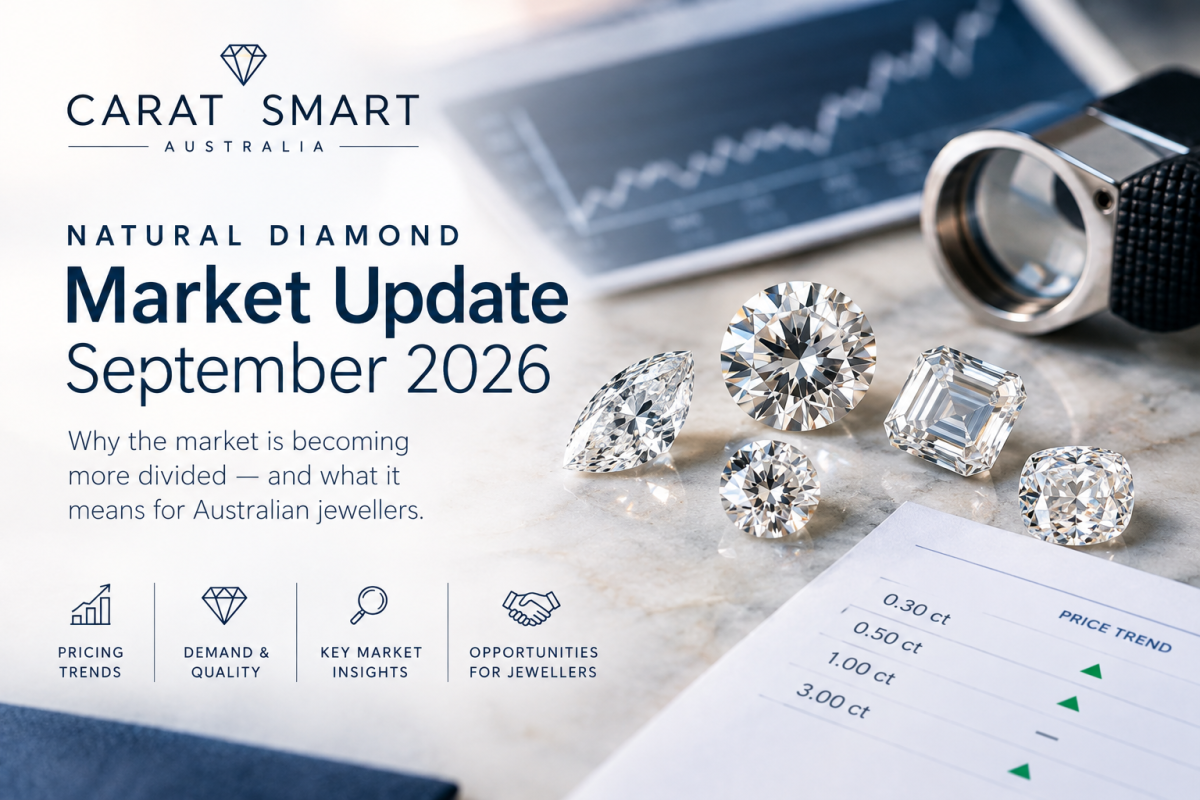
There are also early signs that some parts of the polished market may be finding greater stability. According to Rapaport's September 2026 market review, the 1-carat Rapaport Diamond Index remained flat in August after 13 consecutive months of decline. The 0.30-carat and 0.50-carat indices both recorded increases during the month, while the 3-carat index also edged higher.
This does not mean that the entire market has turned around. Instead, it highlights how important it is to look at individual categories rather than relying on a single headline figure.
One of the clearest developments in the current market is the growing difference between diamonds that are readily available and diamonds that are genuinely difficult to replace.
Higher-quality stones, unusual shapes, strong colours, attractive proportions and desirable combinations of size, colour and clarity can behave very differently from more commercial goods.
For jewellers, this makes sourcing increasingly important. The cheapest diamond is not necessarily the easiest diamond to sell — and the right stone can sometimes offer considerably better value than simply buying to a specification.
The large price difference between natural and laboratory-grown diamonds is also contributing to a clearer separation between the two categories.
De Beers expects continued price pressure on laboratory-grown diamonds and believes the widening price difference is helping consumers better understand natural and laboratory-grown diamonds as separate product categories.
For natural diamonds, this places greater emphasis on rarity, geological origin, individuality, provenance and the emotional significance attached to a natural stone.
Diamond demand is also becoming broader than traditional engagement jewellery.
Recent consumer research from De Beers indicates that natural diamonds continue to have strong appeal in luxury jewellery, while non-bridal purchases are becoming an increasingly important part of demand.
For Australian jewellers, the current market creates both challenges and opportunities.
With prices having adjusted significantly from previous highs, customers are becoming more price conscious. At the same time, retailers need access to diamonds that offer the right combination of appearance, quality and price.
This makes access to a broad natural diamond inventory increasingly important. Rather than focusing on one particular size or specification, jewellers can benefit from comparing different combinations of carat weight, colour, clarity and cut to find the strongest value for each customer.
The natural diamond market in September 2026 is not simply a rising or falling market. It is becoming a more segmented market.
Some commercial categories remain under pressure, while larger and higher-quality diamonds are showing greater resilience. Recent pricing data also suggests that several polished categories may be moving toward greater stability.
For jewellers, the key is increasingly about sourcing the right diamond rather than simply buying diamonds at the lowest possible price.
At Carat Smart Australia, we work with jewellers to source natural diamonds across a broad range of sizes, shapes, colours and clarities, including certified and non-certified goods.
If you are looking for a particular natural diamond, send us the specification and we'll check what is available.
Carat Smart Australia
Wholesale Natural Diamond Supplier
Suite C7, 223 Bagot Road, Subiaco WA 6008, Australia